Delivery
Driveway Protection During Dumpster Delivery in Pensacola
A roll-off concentrates its load through steel rails and small wheels, not the truck rolling past. How Pensacola sand, shell, pavers, live oaks and storm season change the plan.
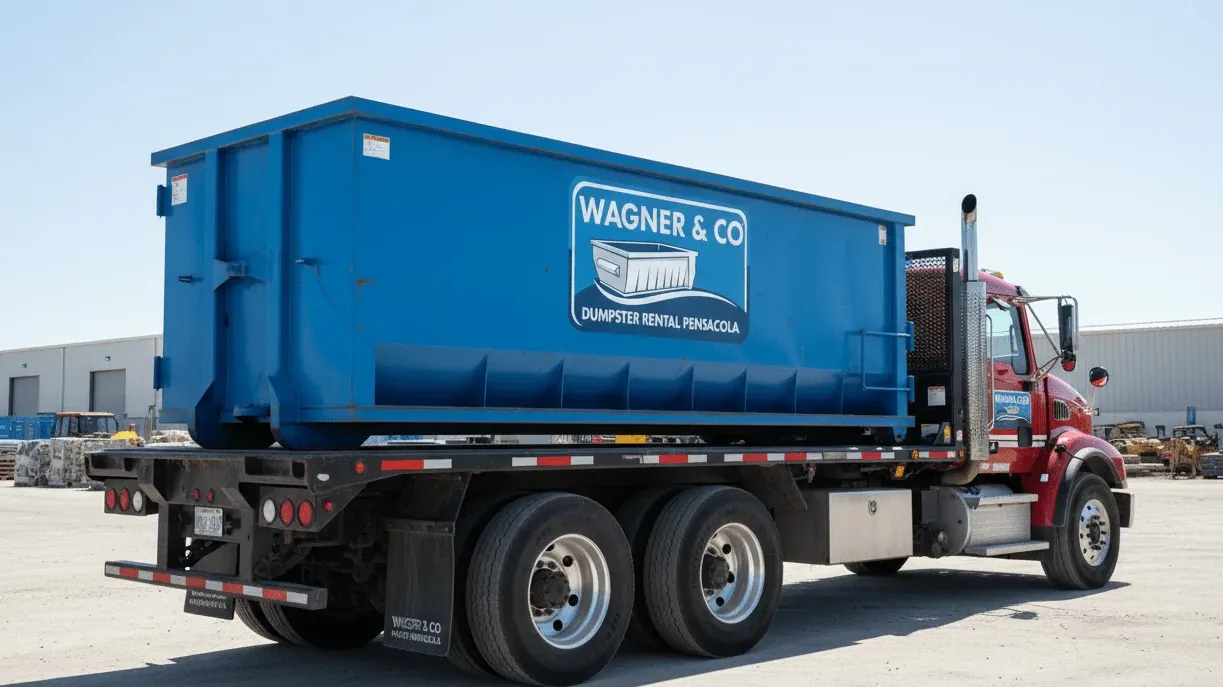
Most people booking a roll-off are thinking about what goes in it. Very few are thinking about what it sits on. After a decade of setting containers around Escambia and Santa Rosa counties, I can tell you the driveway is where nearly all the friction in this job comes from, and almost all of it is avoidable with ten minutes of planning the night before.
Here is how a truck and a loaded container interact with a Pensacola driveway, what we do as standard, and what the ground here — sand, water, live oaks, old brick — changes about it.
The physics, in plain terms
A roll-off truck is heavy before it picks anything up. But total weight is not what marks a surface. Pressure is weight divided by the area carrying it, and that is the whole story of driveway damage.
The truck rolling past is the least of your worries. It spreads load across multiple axles and a lot of rubber, and it keeps moving. The marks come from two places:
- The rails. A container rests on two steel runners a couple of inches wide. Everything in the box — shingles, plaster, wet framing, tile — funnels down through that narrow strip of steel into your surface, and sits there for days.
- The wheels. Rolling off the bed and dragging back on, the container rides on small solid wheels with contact patches the size of your palm, and they are moving under load. That is what gouges asphalt, chips an apron edge and kicks pavers out of line.
Time is the variable nobody accounts for. A static load sitting five days does something a four-second pass never will. Asphalt on a Pensacola afternoon in July is soft enough to take a permanent print from a steel rail.
Protection boards go under the rails. Every time.
Boards go under the rails and at the drop point on every roll-off we set. Not an upsell, not on request, not only when a customer sounds worried. It is part of the delivery, because boards cost us a few minutes and a damaged driveway costs everybody far more.
The second half of that standard is documentation. Drivers photograph the surface on arrival, before the box comes off the truck, and again after placement. If a crack, a spall or a sunken paver is already there, it is in a timestamped photo. That protects you as much as us: with a clear record, nobody argues. Ask and we will send them.
Pensacola ground: sand, with water right underneath
This catches people who moved here from somewhere with real dirt. We sit on sandy soil over a high water table. Sand drains fast and looks dry on top hours after rain, but two feet down it can be saturated, and saturated sand has very little bearing capacity.
Practically: a loaded truck that sits fine on a spot in February can break through in August after a week of storms. It is not the surface giving way, it is the ground under it. Once a loaded roll-off truck is down in soft sand, getting it out does more damage than the original job was worth. Addresses near Bayou Texar, Bayou Chico and Bayou Grande hold water long after the rain stops — tell us, and we will plan for it rather than discover it.
Surface by surface
| Surface type | Main risk | What we do | What you can do |
|---|---|---|---|
| Newer poured concrete | Corner and apron-edge chipping at the wheel transition | Boards under rails and drop point; stay off the apron edge | Flag any thin or recent pour |
| Older cracked concrete | Existing cracks widen; shifted slabs rock under load | Photograph every crack; sit the box across sound slab, not a joint | Tell us it is cracked before delivery day, not after |
| Asphalt | Rail impressions and wheel gouges, badly in summer heat | Boards always; morning drops in hot months; short drag distance | Ask for an early slot in July and August; never a fresh sealcoat |
| Pavers and brick drives | Units sink, tilt or kick sideways as the sand bed migrates | Wider board coverage across multiple units, or recommend elsewhere | Consider a smaller box or the street; accept some settling |
| Crushed shell | Rutting and displacement; shell packs aside and the box tilts | Boards on a levelled area; confirm the box sits flat before leaving | Rake and top up shell after pickup — routine out here |
| Sand or sandy two-track | Truck bogging, deep ruts, uneven settling over the rental | Assess bearing on arrival; refuse a bad spot rather than make it worse | Lay plywood in advance for a long job; do not water it beforehand |
| Dirt and clay-sand rural drives | Deep rutting when wet, which then channels water and worsens | Reschedule rather than run a loaded truck over saturated ground | Give us a dry-weather window; a day beats months of ruts |
| Historic brick streets and old aprons | Displaced brick, damaged edging, tight turns against curbing | Smaller container, careful approach, extra boards, sometimes a hard no | Check right-of-way rules early and stay flexible on placement |
| Gravel | Rutting and stone displacement, base showing through | Boards over the wheel path and rails | Regrade and top up after pickup |
Rain, and the two days after
Gulf Coast rain is not a drizzle, and the summer pattern is predictable enough to plan around: heat builds through the morning, storms roll in mid-afternoon, clear by evening. The ground is what stays changed. Our rule is that we would rather move a delivery a day than leave two ruts you look at every morning for five years. We watch the National Weather Service forecast on delivery mornings, and if your ground needs another day to drain we will say so.
Hurricane season
Season runs June 1 to November 30, and it changes the calculus on anything sitting outside. Two rules we hold to:
- Do not leave a container on soft, saturated ground with a system in the Gulf. Days of rain ahead of landfall turn a firm spot soft, and a heavy box then settles, tilts and becomes very hard to retrieve when the roads reopen and everybody wants a truck at once.
- Low and capped beats full and heaped. Loaded level with the rails and tarped, a container handles wind and rain. Heaped debris becomes airborne debris, and a box full of rainwater is a load nobody can lift.
If a storm is named and pointed this way, call and we will pull or swap the box early. Our storm debris cleanup guide covers the after side, including why vegetative debris stays a separate clean load.
Placement judgement
The best spot is level, firm, off the apron edge, clear of the garage door swing, and turned so the rear doors open toward your work area instead of a fence. A box on a slope loads unevenly and is harder to get back on the truck.
What is buried under there
On rural properties in north Escambia and Santa Rosa, the things that matter are the ones you cannot see. Never let a loaded container sit on a septic tank, over a drain field, or on a well head. Drain field lines are shallow and crushing them is genuinely expensive. In town the equivalents are sprinkler heads, irrigation lines and a French drain along the side of the house — all inches down, all failing quietly under a rail. If you are digging as part of the project, Sunshine 811 locates public utilities, though private lines past the meter are on you. Notice requirements change, so confirm the current rules before you break ground.
Piers, crawlspaces and the foundation line
The historic stock in North Hill, Seville, East Hill and Old East Hill — Victorians, Creole cottages, shotgun houses, craftsman bungalows — sits on brick or masonry piers over a crawlspace. That perimeter is more fragile than a slab looks. So we do not park a loaded container hard against the foundation line, and we never block or sit over a crawlspace vent or the access hatch. Your trades need in there for plumbing, ductwork and to look at the sill and band joist, which in this termite belt is exactly where the bad news lives. Our notes on renovation debris in Pensacola's historic homes cover the salvage and asbestos side.
Overhead: look up first
The hoist arm goes well above 20 feet when it tips a container off. Every driver here says the same thing about the number-one overhead obstruction in this town: live oaks with low, spreading limbs and Spanish moss hanging off them. Water oaks and magnolias do it too. After trees it is the service drop from the pole, then gutters, porch overhangs and carport roofs. A spot a car fits under is not a spot a container can be set in.
Approach and access
Give us roughly 60 feet of straight run to set and retrieve, and about 10.5 feet of width at the tightest pinch — gate posts, parked cars, the gap between house and fence.
Original driveways in North Hill, Seville and East Hill were laid out for narrow cars and often measure well under that, and some of those houses have no driveway at all. Not a dealbreaker: it means the street, or a smaller box, or both. A 10 yard container fits places a 30 yard never will, and for concrete and heavy debris the small box is the right call anyway. Our guide to picking a dumpster size works through the trade-off.
Street placement
Putting the box on the street solves the surface problem completely and creates a different one: you are in the right-of-way, which generally means a permit, cones or reflective markers, and limits on how long it stays. On a narrow historic street where the container takes a travel lane, expect more scrutiny. Exterior work in a historic district can also need Architectural Review Board sign-off before it starts. Requirements and fees change — confirm with the City of Pensacola or Escambia County for your address, and see our breakdown of dumpster permits in Pensacola.
Beach and barrier island access
On Pensacola Beach and Perdido Key, driveways are short, sandy and frequently shell or paver over a sand bed. Access points are restricted, dune areas are protected, and there is no version of this where a truck crosses a dune line. Plan on a smaller container, boards, and the box going where it can go rather than where you would prefer. Check our service area coverage for island addresses.
Before delivery day
- Move the cars the night before, not the morning of. A truck waiting on a car is a truck making a rushed placement decision.
- Mark the exact spot with cones, chalk, stakes or tape, and text us a photo. Ninety seconds removes all ambiguity.
- Unlock the gate and clear the path — bikes, cans, boat trailer, basketball hoop.
- Tell us about anything soft, sandy, cracked or buried. Septic, well, drain field, irrigation, French drain, a slab that already moved, a corner that stays wet.
- Lay your own plywood for a long or heavy job. Three-quarter-inch sheets along the rail line, on top of our boards, are cheap insurance.
None of this is complicated. It is the difference between a delivery you forget and one you remember. Most of our residential dumpster rentals go in, sit a few days and come out with nothing to report, because somebody thought about the ground first.
Wagner & Co Dumpster Rental Pensacola has been placing roll-offs in Escambia and Santa Rosa counties since 2016, and Ross Wagner still takes the calls about tricky driveways himself. Tell us the address, the surface and the job, and we will say honestly whether it works, what size fits, and whether the street is the smarter play. Boards standard, arrival photos standard, flat-rate pricing so the answer does not change on delivery day. Call (448) 288-5053 or reach out here for same-day and next-day delivery, next-day swap-outs and 10, 15, 20, 30 and 40 yard roll-offs.
Questions this guide did not answer? Call (448) 288-5053. We would rather spend two minutes on the phone than have you order the wrong container.