
Storm Cleanup
Hurricane and Storm Debris Cleanup in Pensacola: What Goes Where
Hurricane season runs June 1 to November 30 in Escambia County. What to pull, what to save, how wind and water debris differ, and where each pile actually goes after a storm.
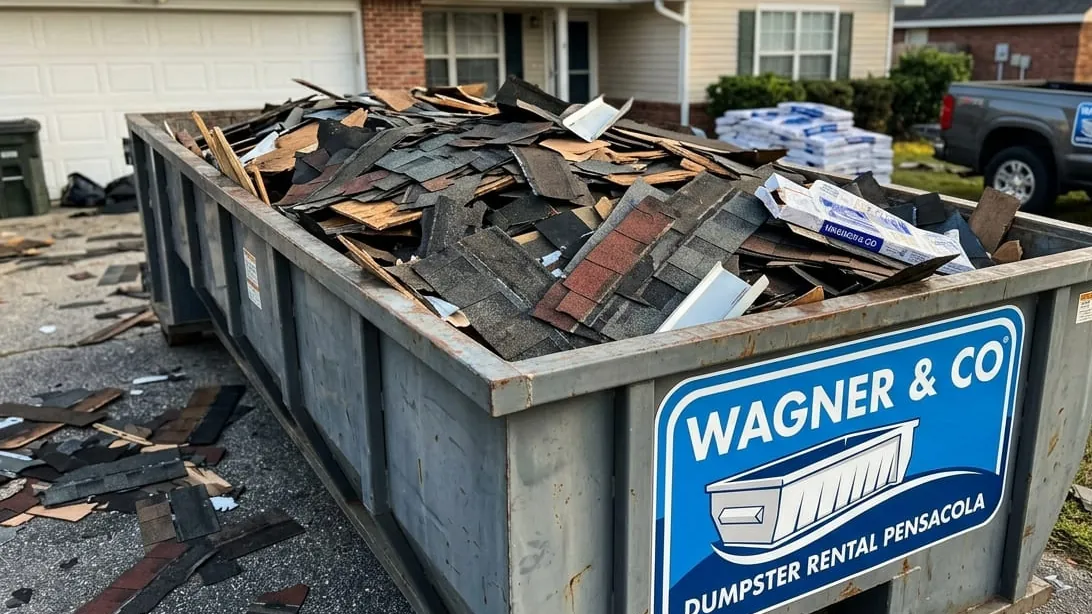
Hurricane season runs June 1 to November 30. Half the year, every year, and in Escambia County it is a calendar item, not an emergency. Most seasons pass with a few squally afternoons and a limb across the driveway. Some do not. If you have lived here a decade you know which two storms everybody measures the rest against.
This is for the homeowner three or four days out — power maybe back, roof tarped or not, a water line on the drywall, a yard full of pine. What comes out, what stays, what rides in a container, what goes to the right-of-way, and in what order.
Ivan and Sally are the local yardsticks
Ivan, September 2004, was catastrophic here. It took out a span of the I-10 Escambia Bay Bridge and the region spent years rebuilding — not weeks. Roofs gone, whole neighbourhoods stripped, debris piles sitting on the right-of-way for months because there was more material than trucks.
Sally, September 2020, worked differently. She made landfall near Gulf Shores, then crawled, and the crawling was the problem. Enormous rainfall over a long window flooded Pensacola from the inside out, and barges broke loose and wrecked the Pensacola Bay Bridge construction. Plenty of houses that lost nothing to wind lost the bottom two feet of every room.
Those two storms are why we treat storm debris as two jobs, not one.
Wind damage and water damage are different jobs
Wind gives you exterior material: shingles and underlayment, soffit and fascia, siding, screen frames, carport panels, fence sections and trees. It is bulky, mostly dry, and not on a clock — a blown-off roof section can wait a day while you tarp. Our roofing tear-off size guide covers the shingle maths, and a 20 yard roll-off is the usual answer for a roof section plus siding and fence.
Water is the opposite. Rainfall flooding and surge give you interior material — drywall, insulation, flooring, cabinetry, furniture and contents — and it is on a clock. It is bulkier than people expect, because a gutted room makes several times the volume of the same room intact. A whole-floor gut usually means a 30 yard container or a 40, often with a swap.
If you took both, and after Sally many people did, run them as two loads rather than one mixed pile. It sorts cleaner at the scale.
The 24 to 48 hour clock
Pensacola is more humid than almost anywhere you could pick, which shortens the mould window to roughly 24 to 48 hours from the moment material gets wet. Not a week. Wet drywall, insulation and carpet pad are not drying on their own in August air, and once mould takes hold in the wall cavity you are into remediation instead of cleanup.
So the order is document, demo, then dry. Fans and dehumidifiers work on structure — framing, subfloor, heart pine — not on saturated gypsum and fibreglass.
What has to go
- Carpet and pad. Pad is a sponge and is never salvageable once wet.
- Soaked drywall, cut clean at 12 inches above the water line for a shallow event, or 24 inches where water stood higher or sat longer. A consistent height makes the reinstall straightforward.
- Wet insulation. Batts wick well above the visible line, so pull higher than looks necessary.
- Particleboard and MDF cabinetry, vanities and furniture. Once the core swells it is done.
- Mattresses, box springs and upholstered furniture.
- Cardboard, paper and stored boxes. Wet cardboard is a mould farm inside a day.
- Laminate and engineered flooring, and glued-down vinyl over a wet substrate.
What can be dried and saved
- Solid wood, especially heart pine. Old-growth floors and tongue-and-groove decking survive water far better than anything modern. Dry them slowly and in place where you can.
- Metal — hardware, brackets, appliance shells, metal roofing panels.
- Ceramic tile, glass, solid-surface counters and porcelain fixtures.
- Solid-wood cabinet boxes and doors, if the joints have not opened.
- Old brick, mantels, doors, transoms and hardware — real buyers here, same as in any older-home renovation in Pensacola.
Under the house: the crawlspace
Homes here sit on a slab or on brick and masonry piers with a crawlspace. The older stock in North Hill, Seville and East Hill is nearly all pier-built, and after a flood the crawl is the part people skip.
Do not skip it. A crawl that took water holds soaked insulation, ruined vapour barrier, saturated soil and standing pools that will not evaporate on their own. It feeds moisture straight up into joists, band joist, sill and subfloor, and it brings Formosan subterranean termites to a very attractive dinner. Pull the wet batts and torn barrier, get air moving, and have the framing inspected from underneath. Flex duct that filled with water is scrap.
Pine and oak, not palm
Storm debris in northwest Florida is not palm fronds. It is longleaf and slash pine, live oak limbs, water oaks and magnolia, and it is heavy. A pile of green oak limb wood that looks small will weigh like a concrete job.
Florida separates yard trash from solid waste, so vegetative debris has to ride as a separate clean load to a yard-waste or mulching facility. Never mix it into a construction load — get that wrong and the load is reclassified at the scale. Our yard waste removal service handles the clean vegetative side, and if you have wind and water debris both, that is two containers or two staged pulls. Facility acceptance does change, so confirm current requirements with Escambia County before you load.
Where storm debris actually goes
| Debris type | Container, right-of-way pile or other route | Note |
|---|---|---|
| Soaked drywall, insulation, carpet and pad | Container, as a C&D load | Out within 24–48 hours |
| Ruined furniture, mattresses, contents | Container, or right-of-way household pile after a declared event | Photograph before it leaves |
| Shingles, underlayment, felt, roof decking | Container, kept as a clean roofing load | Pre-1980 felt is a stop-and-test moment |
| Siding, soffit, fascia, screen frames, fence | Container, as a C&D load | Light but bulky — fills volume fast |
| Pine, oak limbs, whole trees, brush | Separate clean vegetative load, or right-of-way vegetative pile | Heavier than it looks. Never mixed with C&D |
| Fridges, freezers, window AC units | Right-of-way white-goods pile or a certified handler | Refrigerant must be recovered — not in our boxes |
| TVs, computers, small electronics | County electronics collection | Kept separate at the curb |
| Paint, solvents, pool chemicals, pesticides, fuel | Escambia County household hazardous waste drop-off | Never in a container or a brush pile |
| Propane cylinders, batteries, tires | Dedicated take-back or county programme | Cylinders are a fire hazard in a loaded box |
| Suspected asbestos siding, floor tile, felt, duct wrap | Licensed abatement contractor only | Never in any container |
| Heart pine, old brick, doors, mantels, hardware | Salvage — keep out of the box | Real resale value on the Gulf Coast |
The right-of-way programme, and what it will not do
After a declared event the county runs right-of-way debris collection. It is free and it works, with three caveats worth knowing before you build a pile.
It is slow — passes can be weeks apart in a bad season, and the first pass is not the last. It is strictly sorted: vegetative, construction and demolition, appliances, electronics and household hazardous each go in their own pile, spaced apart, off the roadway and clear of hydrants, meters and mailboxes. A mixed pile gets skipped, and then it sits. And it is aimed at storm debris at the curb, not at material you carry out of the house during your own gut work.
That last point is where a container earns its place. If you are pulling drywall and cabinets on day two, you need it gone now, not sitting on the verge for six weeks in August heat. Programme details vary by event, so check current guidance with the county and Florida Division of Emergency Management.
Document before you demolish
Photograph everything before anything moves. Wide shots of each room, close-ups of the water line, the exterior from four sides, serial numbers on appliances and HVAC, and the contents before they go out the door. Video walked through with the camera running is worth more than people think. Keep cut samples of flooring and cabinetry in a bag. Open your claim before demo starts.
Florida's insurance rules and claim deadlines have changed more than once in recent years, and I will not pretend to know where they stand the week you read this. Confirm current requirements with your carrier and the Florida Office of Insurance Regulation, and get your adjuster's mitigation instructions in writing before you throw anything away.
Call early — the surge is real
Every hauler from Mobile to Panama City books out at once, because the storm hit all of us at once. Containers, trucks and drivers are finite, and the people who called on day one have them. If a system is in the Gulf and pointed at us, call before landfall. If it has already come through, call before demo, not after the pile is in the yard.
We run same-day and next-day delivery and next-day swap-outs when capacity allows, and capacity is what storms eat. Protection boards are standard, which matters on sandy drives and the short shell and paver drives on Pensacola Beach and Perdido Key — see our note on protecting a driveway during delivery.
Safety on a storm site
- Every downed line is live until proven otherwise, including fences and standing water touching one.
- Floodwater after a storm is category 3 water — sewage-contaminated. Boots, gloves, eye protection, an N95 minimum, and wash afterwards.
- Generators kill people every season. Outside only, well away from windows and doors, never in a carport or garage. Carbon monoxide gets you quietly.
- Nails and screws everywhere. Stiff-soled boots, and a magnet sweep of the drive.
- Stay off a wet or damaged roof. A tarp is worth less than a fall.
Keep it out of the bayous
Water is everywhere here — Bayou Texar, Bayou Chico, Escambia Bay and Pensacola Bay — and bay water quality is watched closely. Nothing gets stockpiled where runoff reaches a bayou or the bay: no gypsum, no treated lumber, no soaked carpet and no chemical containers in a swale, a ditch line or a low corner of the yard. Keep piles back from the water and covered if more rain is coming. Stormwater rules are enforced and do get updated, so check with Florida DEP.
What cannot go in the container
These stay out regardless of the storm: propane cylinders of any size, gasoline and diesel cans, paint, solvents, pool chemicals and pesticides, tires, car and marine batteries, refrigerant appliances, electronics, and any asbestos-containing material from pre-1980 siding, roofing felt, floor tile and mastic, or duct wrap. Household chemicals go to an Escambia County household hazardous waste drop-off. Our fuller list of what can and cannot go in a dumpster in Escambia County covers the everyday version. Acceptance rules change, so ask when you book.
Rough numbers from storm jobs we have run: one room gutted with flooring and contents fits a 10 yard box, a flooded first floor is a 20 or 30, a whole-house gut is a 40 with a swap, and wind-only work usually lands at 20. Guess bigger if you are guessing — a second pull costs a day you do not have. Our guide to choosing a dumpster size in Pensacola works through it, and residential roll-off rental covers how delivery works.
If a storm has come through and you are staring at a wet house and a yard full of pine, call Wagner & Co Dumpster Rental Pensacola at (448) 288-5053. We are local, licensed and insured, at 333 N 14th Ave in East Hill, and Ross Wagner has been running roll-offs in this county since 2016. Tell us whether it is wind, water or both and we will get the right box on your drive before the mould clock runs out — or use the contact page if the phones are jammed.
Questions this guide did not answer? Call (448) 288-5053. We would rather spend two minutes on the phone than have you order the wrong container.