Disposal Rules
What Can Go in a Dumpster in Escambia County: The Full List
A working accepted-and-prohibited list for Pensacola and Escambia County roll-offs, covering construction debris, Florida's separate yard trash rule, asbestos in pre-1980 stock, hazardous waste drop-offs and what happens when a load gets rejected.
The most common call we get at the yard on N 14th Ave is not about size or scheduling. It is some version of "can I throw this in?" Fair question. The rules in Escambia County are not complicated once somebody lays them out, but they are not intuitive either, and Florida draws one line in particular — between yard trash and solid waste — that catches out almost everyone who moved here from somewhere else.
Ross Wagner has been running roll-offs in Pensacola since 2016. What follows is the working list we give customers before we drop a container: what goes in, what does not, and where the banned material has to go instead. Rules change and agencies update their programs, so confirm anything critical before you commit to a plan.
The easy half: what goes in without a conversation
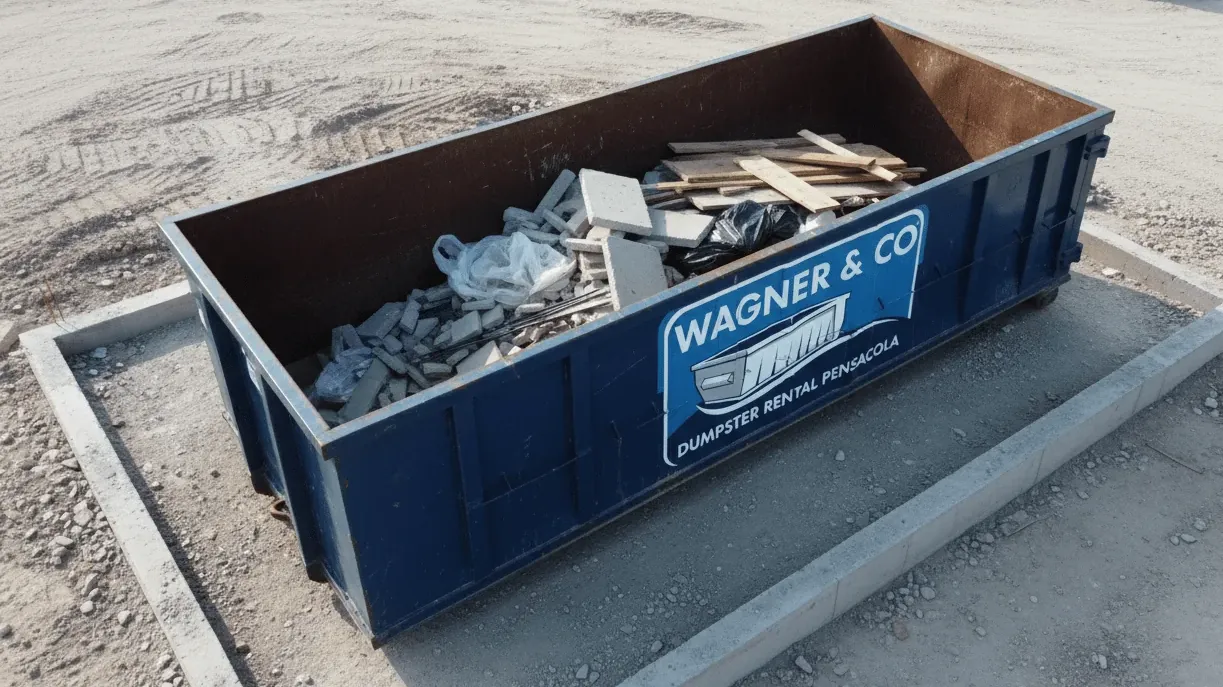
Ordinary construction and demolition debris is the bread and butter of a roll-off here. Framing lumber, plywood and OSB, drywall, plaster and lath, trim, subfloor, doors, windows, cabinetry, countertops, tub surrounds, siding, decking and fencing all load without a second thought.
Old-growth material from the historic stock is fine too. Heart pine flooring, tongue-and-groove decking, beadboard, century-old framing gone hard as iron — all accepted, though much of it is worth pulling first. Brick and block rubble, mortar and chunks of old chimney and pier masonry go in, but weight climbs fast and heavy material belongs in a dedicated concrete and heavy debris container.
Roofing is accepted — shingle, underlayment, metal panels, flashing — and multi-layer tear-offs off the old stock are routine for a roofing tear-off container. Flooring of every kind, carpet and pad, furniture, mattresses (with a caveat below), appliances that never held refrigerant, and general household junk out of a garage, shed or storage unit all go in on a cleanout job.
Yard trash is a separate legal category in Florida
This is the rule that surprises people, so read it twice. In Florida, yard trash is not solid waste. Vegetative debris — limbs, brush, branches, grass clippings, hedge and palm trimmings, leaves, pine straw — is a distinct regulated stream, and it is supposed to go to a yard-waste or mulching facility as a separate, clean load. Not mixed with drywall. Not thrown on top of a demolition pile because there was room left at the back of the container.
Mix them and the load gets reclassified at the scale. A container booked as clean vegetative debris that shows up with a bucket of scrap and three sheets of plywood in it stops being a yard-waste load, with a different destination and different handling. Easily avoided: book two loads, or book a dedicated yard waste removal container and keep it honest.
One local wrinkle: Pensacola tree debris is pine and live oak, not palm. Longleaf and slash pine, live oaks hung with Spanish moss, water oaks, magnolias. Green limb wood off those trees is dense and wet, and a 20-yard box of live oak limbs weighs far more than it looks like it should. Assume heavy and size accordingly — our notes on choosing a dumpster size in Pensacola cover weight in detail.
The list: accepted, prohibited, and where it goes instead
| Material | Accepted? | Where it goes instead |
|---|---|---|
| Framing lumber, plywood, sheathing, heart pine and old framing | Yes | — |
| Drywall, plaster and lath, insulation | Yes | — |
| Brick, block, mortar and concrete rubble | Yes, but weight-limited | Dedicated heavy debris container |
| Roofing shingles, felt, metal panels, flashing | Yes — pre-1980 felt tested first | Abatement contractor if felt tests positive |
| Flooring, carpet, pad, tile, hardwood | Yes, once asbestos is cleared | Abatement contractor for pre-1980 tile and mastic |
| Cabinetry, doors, trim, mantels, hardware | Yes | Architectural salvage buyer, if it has value |
| Furniture, household junk, clothing, boxes | Yes | — |
| Yard trash: limbs, brush, grass, hedge trimmings | Not in a mixed load | Separate clean load to a yard-waste or mulching facility |
| Stumps and root balls | By arrangement, separate load | Yard-waste facility |
| Wet paint, stain, thinner, solvents | No | County household hazardous waste drop-off |
| Fuel, motor oil, antifreeze, brake and transmission fluid | No | Hazardous waste or oil-recycling site |
| Pesticides, herbicides, pool chemicals | No | Household hazardous waste drop-off |
| Propane tanks, any pressurised cylinder, full aerosols | No | Cylinder exchange or hazardous waste program |
| Batteries — automotive, lithium, rechargeable | No | Retail take-back or hazardous waste drop-off |
| Tires, on or off the rim | No | Tire dealer or county waste tire program |
| Refrigerators, freezers, window and split AC units, dehumidifiers | Not with refrigerant in them | Certified refrigerant recovery, then a metal recycler |
| Electronics, televisions, CRT monitors | No | County electronics recycling |
| Mattresses and box springs | Yes — but declare them up front | Often handled as a separate stream at the facility |
| Medical waste, sharps, biohazard material | No | Pharmacy or Health Department take-back program |
| Contaminated or fuel-soaked soil | No | Permitted facility, with a waste profile first |
| Asbestos-containing material, any form | Never, in any container | Licensed asbestos abatement contractor |
| Scrap metal, appliances, ductwork, pipe | Yes — but pull it first | Metal recycler, where it has value |
The hard no list, and why each item earns its place
Liquids are the biggest single offender. Wet paint, thinner, sealer, roof coating, adhesive, pool chemicals, weed killer and anything automotive. Liquids leak through the seams of a container, run out onto the driveway, and in a summer downpour end up in the storm drain. Dried-out latex in an open can is treated differently from a full one, but do not guess — ask.
Pressurised cylinders are the second. Propane bottles, camping canisters, CO2, old fire extinguishers, oxygen and acetylene. A cylinder that survives the tip may not survive the compactor, and that is a safety incident, not a paperwork problem.
The rest — batteries, tires, medical waste, refrigerant appliances, contaminated soil, electronics — are banned because Florida routes them through a separate tracked pathway. The Florida Department of Environmental Protection sets the framework and Escambia County runs the local programs; the county's waste services pages are where to confirm current drop-off arrangements. Our overview of recycling and disposal in Escambia County covers the same streams from the other side.
Asbestos: the pre-1980 problem in the old part of town
Pensacola was founded in 1559 and the housing shows it. North Hill, Seville, East Hill and Old East Hill hold 1880s to 1930s Victorians, Queen Annes, Creole cottages, shotgun houses and craftsman bungalows — nearly all of it renovated at least once in the mid twentieth century. That is where the asbestos lives.
What we actually see come out of these houses:
- 9x9 and 12x12 floor tile and the black mastic under it — the classic find, usually under two later layers of vinyl
- Pipe and duct wrap — in the crawlspace, on old heating lines and around ductwork
- Popcorn and textured ceilings — sprayed over original plaster in the sixties and seventies
- Cement-asbestos siding — brittle grey shingle siding, often hiding under later vinyl
- Roofing felt and built-up roof layers — stop and test on any pre-1980 tear-off
We cannot take asbestos-containing material in any container, in any condition, wetted down or bagged or not. It goes to a licensed abatement contractor and a permitted disposal site, full stop. Asbestos is regulated in Florida by DEP and the Florida Department of Health, and demolition generally triggers a NESHAP inspection and notification before anything comes down — that can apply even when the survey comes back clean. Thresholds change, so verify the current process with the agency rather than relying on how a job went three years ago. More on this in our guide to historic home renovation debris in Pensacola.
Lead is the companion problem. Any house built before 1978 is presumed to have lead paint, and contractors disturbing painted surfaces work under the EPA Renovation, Repair and Painting rule: certified firm, contained work area, specific cleanup. Lead-painted wood is not banned from a container the way asbestos is, but the work practices that produce it are regulated and dust control matters.
Household hazardous waste, and no paint take-back in Florida
Escambia County operates a household hazardous waste drop-off, and that is the answer for the whole liquid and chemical side of the list: paint, stains, solvents, pesticides, pool chemicals, fluorescent tubes, automotive fluids, batteries and small propane canisters.
One thing trips up newcomers constantly: PaintCare does not operate in Florida. There is no retail paint stewardship scheme here, so the hardware store will not take your half-used gallons back. The county drop-off is the route. It comes up on every garage clearout and all through PCS season, when a single shelf produces fifteen years of chemicals in an afternoon.
Storm debris changes the system for a while
After a declared event the whole picture shifts. Ivan in 2004 and Sally in 2020 are the local reference points, and both meant months of debris management. With a declaration in place the county typically runs right-of-way collection sorted into separate streams at the curb — vegetative, construction and demolition, white goods, electronics, household hazardous waste — and mixing those piles slows or disqualifies pickup on your street.
Curb collection and a rented container are not competitors; most people use both. The curb program takes the limbs and the gutted drywall, a container handles what you want gone on your own schedule. Our hurricane storm debris cleanup guide covers sequencing. Season runs June 1 to November 30, and the time to plan is before the cone shows up.
Pull the scrap and the salvage before we arrive
Two categories are technically accepted but should rarely go in.
Scrap metal pays. Copper pipe and wire, cast iron tub and drain lines, ductwork, aluminium window frames, steel roofing, water heaters. Pulling it first cuts container weight and puts money back against the job. On a whole-house gut it is rarely a small number.
Salvage pays more, and in Pensacola it genuinely does. Heart pine flooring, old-growth framing, five-panel doors, mantels, transoms, clawfoot tubs, rim locks and original hardware, and hand-made brick all have real Gulf Coast buyers. Pulling salvage before the container lands is normal trade practice here, not a hobby. Be aware that Formosan subterranean termites are a serious northwest Florida problem, and plenty of what looks salvageable is hollow once the trim comes off.
Stormwater, the bayous and where the pile sits
Water is everywhere here — Bayou Texar, Bayou Chico, Bayou Grande, Escambia Bay, Pensacola Bay. Bay water quality and seagrass are watched closely, and nothing gets stockpiled where runoff reaches a bayou or the bay. Practical version: keep the pile on the property rather than the street or a swale, cover anything light enough to blow, keep gypsum and painted material out of standing water, and never stage debris downhill of a storm drain. Low-lying streets flood fast in a hard rain.
What happens when prohibited material turns up
Three outcomes, in rising order of expense. The material is spotted at pickup and we leave it — annoying, but cheapest. It reaches the scale and the load is reclassified or a handling charge applied, which lands back on the account. Or the load is rejected outright, comes back to the site, and everything stops until the container is sorted by hand.
Regulatory penalties for improperly disposing of asbestos, hazardous waste or contaminated soil sit in a different category again, and they follow the generator, not the hauler. None of it is hard to avoid. Tell us what is going in before the container arrives, and if you are unsure about one item, ask. For how debris streams sort out on a job site, see our notes on construction debris disposal in northwest Florida and the container sizes we run.
Wagner & Co Dumpster Rental Pensacola has been sorting out what goes where in Escambia and Santa Rosa counties since 2016 — licensed, insured, locally owned, flat-rate, protection boards standard on every drop. If you have a load you are not sure about, describe it to us and we will tell you straight whether it goes in a construction container, a clean yard-waste load, or somewhere else entirely. Call (448) 288-5053 for same-day or next-day delivery, or come see us at 333 N 14th Ave.
Questions this guide did not answer? Call (448) 288-5053. We would rather spend two minutes on the phone than have you order the wrong container.