
Sizing
What Size Dumpster Do I Need in Pensacola? A Straight Answer for Every Job
Ten through 40 yard with real dimensions and honest pickup equivalents, and the local factors that decide it: dense old-house debris, roofing layers, storm water, live oak limbs and PCS season.
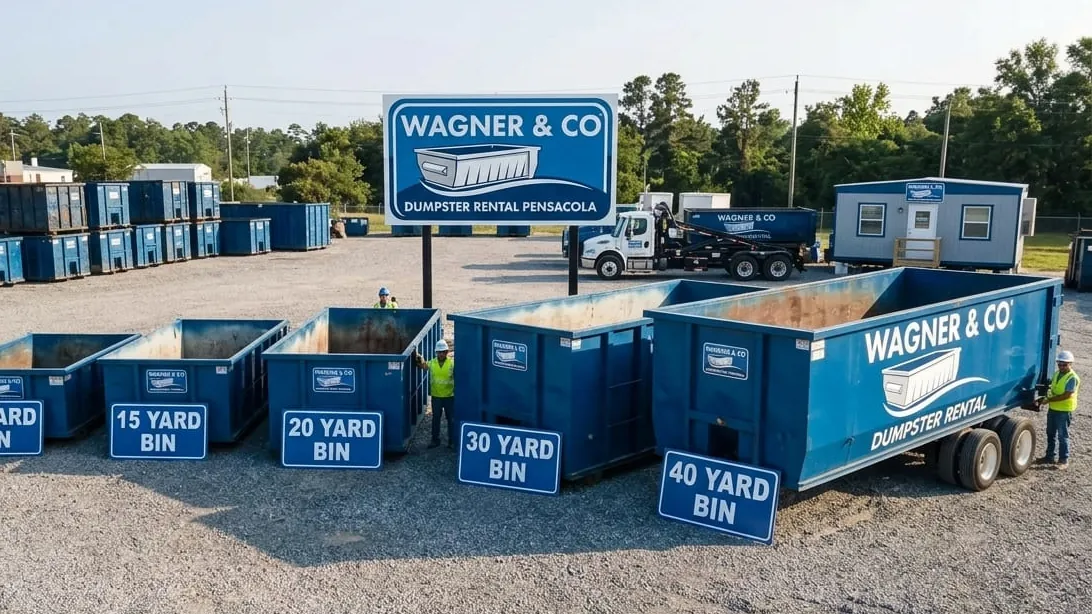
The single question we field more than any other, every week of the year, is some version of "how big a box do I need?" People usually ask it in cubic yards, which is fair — that is how these containers are sold. But in Pensacola the answer is decided by weight at least as often as it is decided by volume, and the guides people find online are almost always written for somewhere else. They assume basements. They assume the debris is 1990s stick-built material. Neither is true here.
Ross Wagner has been setting roll-offs in Escambia County since 2016, out of the yard at 333 N 14th Ave in East Hill. What follows is how we size jobs on this coast: real dimensions for all five boxes, honest pickup-load equivalents, and the local factors that push the answer up or down.
The five sizes, with real numbers
Every container we run is a standard open-top roll-off. The footprints below are the box itself; add clearance around it for the truck. Weight allowances are typical for this market and are confirmed on your order, because material type changes what a container can safely carry down the road.
| Size | Dimensions (L x W x H) | Weight allowance | Honest pickup-load equivalent | What it is actually for in Pensacola |
|---|---|---|---|---|
| 10 yard | 12 ft x 8 ft x 3.5 ft | Lowest — built for heavy, dense material | About 3 full-size pickup loads | Concrete slabs, brick, block, tile, sand and soil. Small bathroom gut. Anything where you will hit the weight limit long before you fill the box. |
| 15 yard | 16 ft x 8 ft x 4 ft | Moderate | About 4 to 5 pickup loads | A single-room remodel, a PCS move-out from base housing, a garage and shed clear-out, a small roof. |
| 20 yard | 22 ft x 8 ft x 4.5 ft | Moderate to high | About 6 pickup loads | The workhorse. Whole-house cleanouts, mid-size renovations, most re-roofs, flooring tear-outs, storm debris on a normal lot. |
| 30 yard | 22 ft x 8 ft x 6 ft | High | About 9 pickup loads | Large renovations, additions, new construction framing waste, estate cleanouts on a big property, commercial turnovers. |
| 40 yard | 22 ft x 8 ft x 8 ft | Highest — volume, not density | About 12 pickup loads | Bulky and light: commercial demolition, large-scale cleanouts, siding, cabinetry, packaging, industrial and institutional work. |
Note the pattern. From 20 up the footprint stops growing and only the walls get taller — a 20, a 30 and a 40 all need the same 22 feet of ground. That matters on a narrow original driveway off 12th Avenue, and it means going bigger does not always cost you room. Our full dumpster size guide has more, including dedicated pages for the 10 yard and the 20 yard.
Weight beats volume on dense material
This is the rule that saves people the most grief. Concrete, brick, block, ceramic tile, mortar, sand and soil run roughly 2,400 to 2,800 pounds per cubic yard. Do that arithmetic on a modest project and it gets serious fast. A 12 by 15 foot patio slab four inches thick is a little over two cubic yards of concrete — already close to three tons before you count the base material that comes up with it. A short driveway apron, a set of front steps, a chimney base: all of these are tonnage jobs disguised as small jobs.
So for clean concrete, brick, block, tile, dirt and sand we put you in a 10 yard and haul it more than once. That is not stinginess — a 20 filled with slab would be far over legal axle weight and would never leave the property. Keeping heavy material separate from mixed debris also lands it at the right facility. More in our concrete and heavy debris service, and in the guide to what can and cannot go in a container in Escambia County.
Roofing is sized by squares and layers, not by roof area
Roofers already think this way, homeowners usually do not. A roofing square is 100 square feet. What fills the container is squares multiplied by layers, and on Pensacola's older stock the layer count is the variable that ruins estimates. Two layers is common. Three turns up. A 25 square roof with one layer of architectural shingle and a 25 square roof with three layers are completely different loads.
Add the local wrinkles. Florida's insurance market and the Building Code's wind-uplift and secondary-water-barrier rules have driven a long re-roof wave, and the 25 percent rule often pushes a repair into a full replacement. Metal is common on the coast and on historic homes; it strips lighter than shingle but awkwardly. On pre-1980 roofs, old felt is a stop-and-test moment — we cannot accept asbestos-containing material in any container. Most single-family tear-offs land in a 20; a big or multi-layer roof goes 30. See the roofing tear-off size guide for the layer arithmetic.
The Pensacola housing split, and why it changes the box
Newer construction in south and north Escambia is slab-on-grade and behaves like the rest of Florida. The historic core does not. North Hill, Seville, East Hill and Old East Hill sit on brick or masonry piers with a crawlspace underneath, and everything above that crawlspace is denser than modern debris.
Heart pine flooring, old-growth framing, tongue-and-groove decking, plaster and lath, and two or three generations of flooring layered on top of each other all weigh substantially more per cubic foot than the equivalent modern material. Plaster and lath in particular is brutal — it is essentially sand and gypsum on wood strips, and a single room of it will surprise you. The working rule on the old stock is size down one and plan on a swap. A 20 hauled twice beats a 30 you cannot legally move.
Pull the salvage first. Heart pine flooring, beadboard, doors, mantels, transoms, hardware, clawfoot tubs and old brick all have buyers on the Gulf Coast, and taking them out shrinks the load. Budget for surprises too: Formosan subterranean termites routinely turn a cosmetic remodel structural once the trim comes off. See our notes on historic home renovation debris, and remember that exterior work and demolition in the districts can need Architectural Review Board approval first — confirm current thresholds with the City of Pensacola, because they do change.
No basements — which is exactly why northern guides overshoot
Pensacola houses do not have basements. Not the slab houses, not the pier houses. Every sizing article written in Ohio quietly assumes a basement's worth of accumulated volume, and that assumption is why people here order a 30 for a cleanout that a 20 handles comfortably.
The volume on a local cleanout comes from somewhere else: the garage, the attic, the backyard shed, and whatever got shoved into the crawlspace access by a previous owner. Detached garages and workshops behind the historic houses hold decades of material. Walk all four of those before you call, and you will be within one size of right. Our home cleanout checklist is built around exactly that walk-through, and an estate clearance follows the same order.
Storm work: smaller box, more hauls
Hurricane season runs June 1 to November 30, and this town remembers Ivan in 2004 and Sally in 2020 as events, not statistics. After water gets in, the material coming out is saturated. Wet drywall, soaked carpet and pad, and waterlogged insulation weigh several times what the same material weighs dry. A flooded house wants a smaller container and more hauls, every time — usually a 20 on next-day swaps rather than a 30 sitting for a week.
Move fast on the interior: in this humidity, water intrusion becomes a mould problem in roughly 24 to 48 hours. Never stage a wet pile where runoff reaches Bayou Texar, Bayou Chico or the bay. Our guide to hurricane and storm debris cleanup covers the whole sequence, from tarping through the final haul.
Tree debris rides separately
Our storm debris is pine and live oak, not palm. Longleaf and slash pine, water oaks, magnolias, live oaks hung with Spanish moss — heavy limb wood and whole trunks, not light frond debris.
Florida separates yard trash from solid waste, so vegetative debris has to go as a separate clean load to a yard-waste or mulching facility. Toss a few limbs on top of a construction load and the whole load can get reclassified at the scale. Order the wood as its own container through yard waste removal. Rules on separation and acceptable material are set at state and county level and get revised, so confirm current requirements with Escambia County or Florida DEP before you mix anything.
PCS season: May through August
NAS Pensacola, Corry Station and Whiting Field over in Milton mean permanent-change-of-station moves are a season here, not an occasional event, and it runs roughly May through August. A move-out from base or rental housing is almost always a 15 or a 20: furniture that is not worth shipping, the garage, the storage unit, the patio set that has been through three summers.
The catch is that everybody needs one in the same twelve weeks, so book early. We keep same-day and next-day delivery available, but in July it gets tight. The PCS move-out cleanout guide has the timeline.
Will it actually fit on your property?
Size on paper is half the job. The truck needs roughly 60 feet of straight approach, about 10.5 feet of width, and 20 or more feet of overhead clearance for the hoist arm as the box tilts off. That last one is what people forget, and on the historic streets it is low live oak limbs that stop us — a canopy over Strong Street is a hard no for a 40.
- Narrow original driveways. Many 1920s drives were sized for a Model A. Some houses have no driveway at all, which means a street placement and a conversation about right-of-way permits.
- Brick streets. Parts of North Hill and East Hill still have them. We work on brick, but placement gets deliberate.
- Sandy and shell drives. On Pensacola Beach and Perdido Key a loaded truck will rut a soft or shell drive, so we plan the approach and sometimes stage at the street.
- Protection boards come standard on every delivery. Read how we protect a driveway if you are worried about pavers or a fresh apron.
- Call 811 before any digging near the placement area — Sunshine 811 is free and required.
How to describe your job on the phone
Give us five things and we will size it in about a minute:
- The material. Not "junk" — say concrete, shingles, plaster and lath, furniture, wet drywall, limbs. Material decides weight before anything else.
- The age of the house, and whether it is slab or on piers with a crawlspace. That tells us the density.
- The scope in real units. Squares and layers for a roof. Square feet and thickness for a slab. Number of rooms for a gut. Which structures for a cleanout.
- The placement. Driveway or street, width, surface, and what is overhead.
- The schedule. One haul or a swap cycle? Next-day swap-outs let a smaller box do a bigger job.
Get those right and the box is obvious. Get them wrong and you either pay for air or get a container that cannot legally be lifted.
Wagner & Co Dumpster Rental Pensacola has been sizing these jobs since 2016 — licensed, insured, locally owned, flat-rate pricing, protection boards standard. We serve Pensacola, Escambia County, Santa Rosa County and northwest Florida from our East Hill yard. Tell us what is coming out and where it has to sit, and we will tell you straight which box fits. Call (448) 288-5053 or use the contact page and we will get back to you the same day.
Questions this guide did not answer? Call (448) 288-5053. We would rather spend two minutes on the phone than have you order the wrong container.