Roofing
Roofing Tear-Off Dumpster Size Guide for Pensacola: Squares, Layers and the Right Box
Roofing is a weight problem, not a volume one. How to size a tear-off container by squares and layers in Pensacola, why a 40 yard is the wrong box, and what the old stock hides.
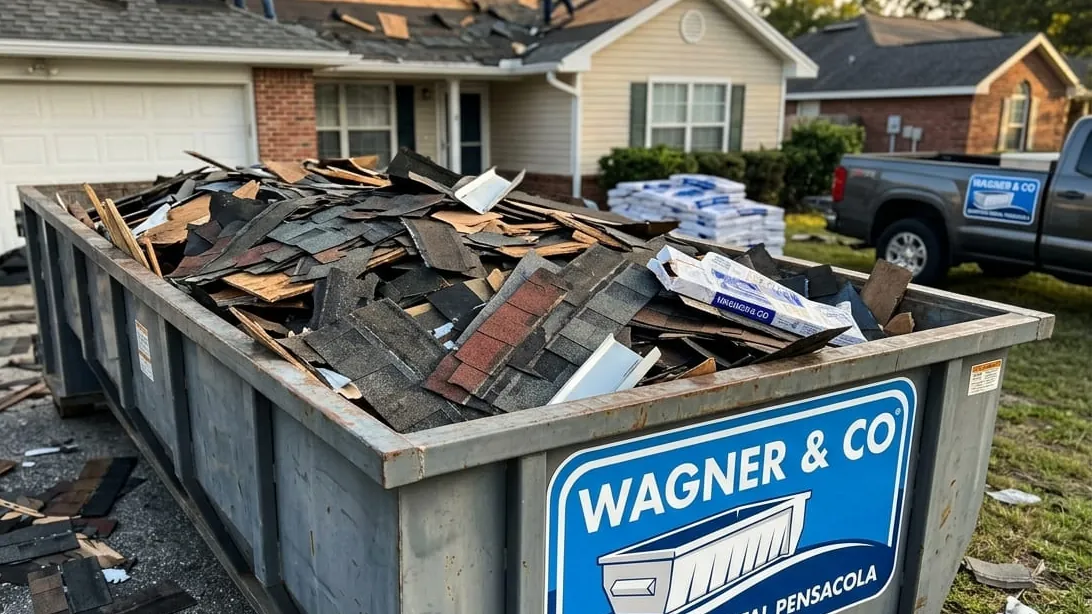
Most debris we haul is a volume problem: look at the pile, guess the pickup loads, pick a box. Roofing is not that. A tear-off is a weight problem wearing a volume costume, and plenty of people in Escambia County get caught out by it every summer.
A container loaded with asphalt shingle hits its legal road weight long before the debris reaches the top rail. Size a roofing job by roof area and you will order too big, load it too full, and end up with a box that cannot legally move — the one failure that costs a crew a day.
Ross Wagner has been setting roll-offs for roofers in Escambia and Santa Rosa County since 2016. Here is how we size a tear-off, in the units roofers use.
Squares and layers, not square feet
Roofers measure in squares. One square is 100 square feet of roof surface. A 1950s ranch off Creighton Road might be 18 to 22 squares; a two-storey Queen Anne in North Hill with dormers, valleys and a wraparound porch can run 35 or more. Squares always exceed the house footprint; slope adds surface.
Then comes the number people forget: how many layers are coming off. Two layers is not a bit more debris. It is roughly double the tonnage off the same roof, and it changes the container.
Rough weight ranges we plan against — planning figures, not guarantees, since the scale is the only number that counts and wet debris weighs more than dry:
- Three-tab asphalt shingle: roughly 200 to 250 pounds per square, nails and felt included.
- Architectural or dimensional shingle: roughly 350 to 450 pounds per square. The laminated shingle dominating new Florida work is close to double a three-tab.
- Cedar shake: lighter per square than architectural asphalt but far bulkier and non-compacting; volume runs out first.
- Old roofing felt and patch layers: unpredictable, and heavier than anyone guesses.
- Metal panel: the lightest by far, and it should not go in a container at all.
Do the arithmetic before you order. Twenty-five squares of architectural shingle in one layer is four to five tons. Add a second layer of three-tab and you are pushing seven tons off one house — a routine Pensacola job, not a worst case.
Multi-layer roofs are normal on the old stock
Pensacola was founded in 1559 and the housing shows it. East Hill, Old East Hill, Seville and North Hill hold 1880s to 1930s Victorians, Creole cottages, shotgun houses and craftsman bungalows re-roofed five or six times across a century, because layering over the old roof used to be routine and cheap.
So the homeowner says 22 squares, one layer, the crew gets two courses in and finds a second layer of three-tab over old felt nailed straight to tongue-and-groove decking. On the oldest houses cedar shake still turns up under that, over spaced sheathing. Lift a shingle at the eave and at a valley before you order — ten minutes saves an emergency swap. More in our notes on renovation debris from historic Pensacola homes.
Metal roofing: pull it, do not bury it
Metal is common on this coast — on bayfront and beach houses where wind-driven rain and salt eat asphalt, and on historic homes where standing seam or a 5V crimp panel is the period material. It is light, so a metal tear-off almost never presents a weight problem. It also has scrap value, and burying panels under three tons of shingle throws that away. Strip the metal first, stack it flat, and either run it to a scrap yard or tell us so we can plan a clean separate load. Same for copper flashing and valley metal — our guide to recycling in Escambia County covers what is worth pulling.
The sizing table
This is the table we work from. Where a job straddles two rows, take the smaller box and plan a swap: a same-day or next-day swap is a scheduling item, an overloaded container is a job stoppage.
| Squares | Layers | Container | Notes |
|---|---|---|---|
| Up to 12 | 1 (three-tab) | 10 yard | Small ranch, garage or porch roof. Easiest box on a narrow drive. |
| Up to 12 | 1 (architectural) | 15 yard | Laminated shingle is near double three-tab. Take the extra room. |
| 12–20 | 1 | 15 yard | The most common single-layer residential tear-off here. |
| 20–30 | 1 | 20 yard | Larger ranch or simple two-storey. Comfortable throwing height. |
| 12–20 | 2 | 20 yard | A second layer roughly doubles tonnage. Treat it as a bigger roof. |
| 30–40 | 1 | 30 yard | Big or cut-up roof. Watch weight, not fill height — it reaches its limit low. |
| 20–30 | 2 | 30 yard, or a 20 hauled twice | Two hauls is often cleaner on a tight historic lot. |
| Any | 3 or more | 20 or 30 yard with a booked swap | Three layers is a tonnage job. Schedule the swap up front. |
| Any | Metal panel | 15 or 20 yard, or scrap it | Volume-driven, not weight-driven. Pull it for scrap. |
Box dimensions are on our dumpster sizes page, and the Pensacola sizing guide covers mixed debris.
Why nobody should order a 40 for a tear-off
We rent 40 yard containers and they are right for whole-house cleanouts, framing lumber and storm debris — material that runs out of space before it runs out of weight. Shingle is the opposite. Fill a 40 with asphalt tear-off and it becomes a box we cannot legally put on the road, which means someone pulling shingles back out by hand. It is also long, and needs straight driveway the historic side of town rarely has. Two hauls of a 20 move more roof, faster, than one 40 you cannot lift.
Why so many Pensacola roofs are coming off right now
Three things drive the re-roof wave here, and they compound.
The insurance market is the loudest. Carriers have tightened underwriting on roof age and condition statewide, and plenty of homeowners are replacing a roof that still sheds water because the renewal depends on it. The Florida Office of Insurance Regulation tracks what is current.
The Florida Building Code is second. Escambia County sits in a coastal high-wind zone, and the code governs wind-uplift resistance, fastening schedules and the secondary water barrier — the sealed layer over the deck meant to keep water out if the covering blows off. Anyone who lived through Ivan in 2004 knows why. Requirements are published through the Florida Building Commission.
Third is the 25 percent rule: repair or replace more than a quarter of a roof section inside a twelve-month window and the whole thing generally has to come up to current code rather than be patched. That is how a damaged slope becomes a full tear-off. The rule has been amended more than once and exceptions exist, so confirm how it applies to your address with the Escambia County building department, or the City of Pensacola inside city limits. Code, insurance rules and permit thresholds all change — verify before you commit.
Hurricane season and the timing problem
Season runs June 1 to November 30, and what follows a storm is region-wide: every roofer, adjuster and roll-off from Perdido Key to Milton books out inside about seventy-two hours. Sally did it in September 2020, Ivan on a far worse scale in 2004.
The advice is unglamorous: if the roof is already on the replacement list, do it in spring, not October; if a storm has hit, call before the crew is scheduled rather than after, because the container is often the long pole. The wider sequence is in our guide to hurricane and storm debris cleanup in Pensacola.
If insurance is involved, sequence it properly
Debris is evidence; once it is gone, the claim rests on what you photographed.
- Open the claim first, before the crew starts, not after the roof is bare.
- Photograph everything: each slope wide, close-ups of damage, the exposed decking, the layers at the tear-off edge.
- Keep a sample. A few damaged shingles bagged and out of the weather. Adjusters ask.
- Do not haul before the adjuster has been unless the carrier has said in writing that photographs are enough.
Pre-1980 felt is a stop-and-test moment
Asbestos turns up in old roofing felt, cement-asbestos shingles and flashing mastic on pre-1980 buildings, and Pensacola has a great deal of pre-1980 building. Find a black felt layer or a brittle grey shingle you do not recognise and you stop. Do not dry-sweep it, do not bag it, do not put it in one of our containers — we cannot accept asbestos-containing material in any box, ever.
Have it sampled by a licensed inspector. Asbestos is regulated in Florida by the Department of Environmental Protection, and the work generally triggers a NESHAP inspection and written notification before it starts, with a licensed abatement contractor handling removal. Thresholds change, so confirm with DEP. What we can and cannot take is in our rundown of what goes in a dumpster in Escambia County.
Historic districts: approval can come before the tear-off
If the house sits in the North Hill Preservation District, the Seville Historic District or one of the East Hill districts, exterior work is subject to City of Pensacola historic review. Changing roofing material — asphalt to metal, or metal to shingle — can require Architectural Review Board approval before the old roof comes off. Like-for-like is simpler, but "usually" is not an approval, and rules change. Check with city planning early: boards meet on a calendar, and finding out with a bare deck is a bad afternoon.
Where the box goes
Placement matters more on roofing than almost any job: the crew throws from height and every step costs time.
- Put it on the tear-off side, close to the slope being stripped, not wherever the drive is widest.
- Protection boards go down as standard. Old Pensacola drives are thin concrete, brick or pavers and mark easily; see protecting a driveway during delivery.
- Stay clear of the drip line. A box directly under an active tear-off edge collects everything you did not aim.
- Look up. The hoist arm needs 20 feet or more of clearance, and our live oaks throw low, heavy horizontal limbs that do not read as obstacles from the ground. Power drops to older houses sit low as well.
- Narrow drives and brick streets. Downtown, Seville and North Hill have original single-width drives and brick paving. Tell us what we are backing into.
- Sand and shell. On Pensacola Beach and Perdido Key, short shell or paver drives over soft sand will not always carry a loaded truck. Often the answer is a smaller box on the street with a right-of-way permit.
- Sweep for nails. Roll a magnet over the drive, grass strip and street after every haul. Tear-offs shed thousands of nails, and they find tyres.
On a big or multi-layer job, book the swap when you book the delivery. We run next-day swap-outs, and a crew that knows an empty box lands in the morning works differently from one guessing. More on our roofing dumpster rental page.
Do not leave a roof open overnight
This is the Gulf Coast in summer, and a clear morning tells you nothing about four o'clock. Strip only what you can dry in the same day. Water into a Pensacola house starts producing mould in roughly 24 to 48 hours in this humidity, and tarped-and-hoped never beats staging the job properly. Size the container so the tear-off pace is never limited by a full box.
Talk it through before you order
Tell us the squares, the layers you expect, the material and the street, and we can put the right box in the right spot first time. We are at 333 N 14th Ave in East Hill, serving Pensacola, Escambia and Santa Rosa County, flat-rate with protection boards standard. Call Wagner & Co Dumpster Rental Pensacola at (448) 288-5053 or use the contact page, and we will size the tear-off with you.
Questions this guide did not answer? Call (448) 288-5053. We would rather spend two minutes on the phone than have you order the wrong container.