Recycling
Recycling and Disposal in Escambia County: Where It All Goes
A Pensacola hauler's guide to where Escambia County material actually ends up, and how clean separated loads, salvage and hazardous waste drop-offs keep far more of it out of the Perdido Landfill.
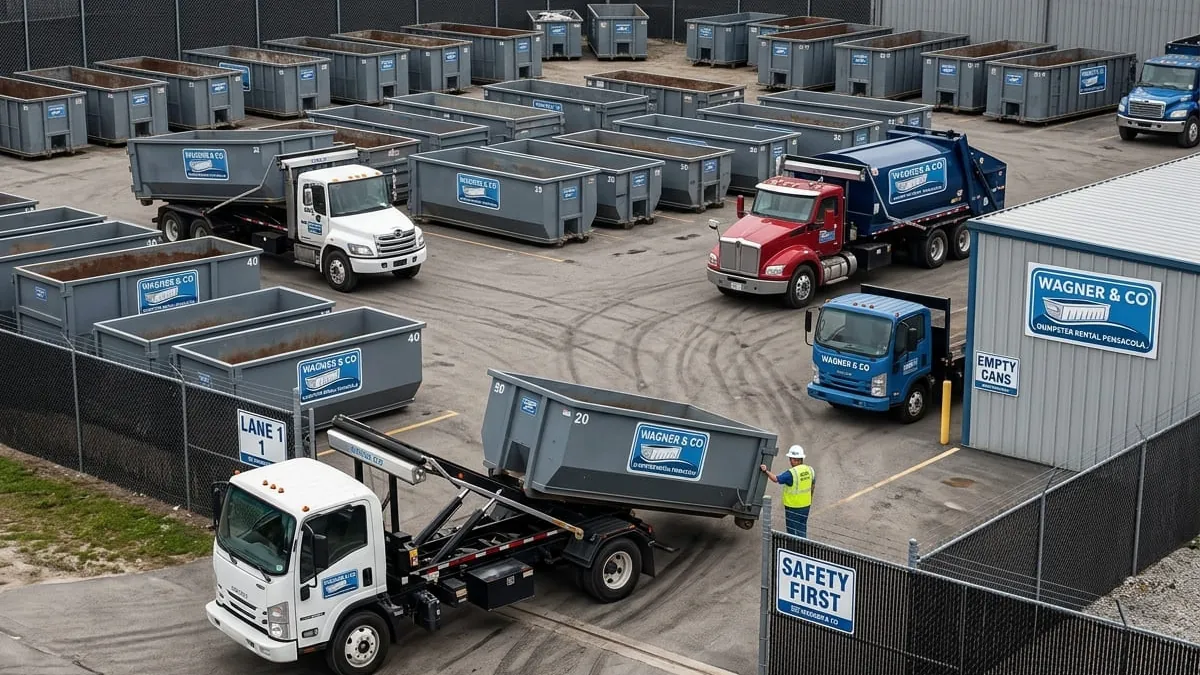
Most of what leaves a Pensacola job site does not have to go in the ground. A fair share does anyway, and the reason is rarely cost or effort — four materials went into one container and all four became landfill. Once clean concrete has drywall dust and a shingle bundle on it, it is not crushable fill, it is mixed construction debris. That is the whole game: separation decided before the truck rolls.
We have hauled in Escambia County since 2016 and get the same questions. Where does this go? What can I keep out of the landfill? What gets a load reclassified at the scale?
Four disposal routes, and they are not interchangeable
People use "recycling" and "disposal" loosely, but four systems operate here, each taking different material.
- Curbside collection handles routine household garbage, and depending on address and hauler, recyclables and yard trash on set days. It is not a renovation tool — set out tear-off shingles and the pile sits there.
- A county drop-off suits the resident hauling a pickup load themselves — a few bags, scrap metal, tires, an old television. Poor for anything needing repeat trips.
- A household hazardous waste collection is a separate stream for the chemistry: paint, fuel, pesticides, pool chemicals, batteries and tubes. None of it belongs in a truck or a container.
- A roll-off container is the tool when volume, weight or duration rules the others out — a gut renovation, a re-roof, a demolition, an estate clearance. Critically, it can run as a clean single-material load when you want material recovered instead of buried.
The right answer is usually a combination of all four. Our guide to what can and cannot go in an Escambia County container has the accepted-materials detail.
The county system and the Perdido Landfill
Escambia County operates the Perdido Landfill on the west side of the county, and it anchors the local solid waste system — disposal, plus yard waste and mulching, scrap metal, tires, appliances, electronics and household hazardous waste depending on the programme. Most commercial loads out of Pensacola end up there or at a transfer point.
One caveat: hours, accepted items, resident-versus-commercial rules and the programme list all change — with season, with funding, and hard after a storm. Do not plan a Saturday around what a website said last year. Confirm current details with Escambia County or, inside city limits, the City of Pensacola.
Yard trash is a separate load. This rule matters most.
Florida separates yard trash from other solid waste. Vegetative debris — limbs, trunks, brush, stumps, leaves — goes to a yard-waste or mulching facility as a separate clean load and gets ground into mulch and boiler fuel instead of buried. It is the most effective diversion move available here, and the rule most often broken by accident.
The failure mode is simple. Somebody clearing a lot throws limbs in the container, adds a rotten fence section, then bags of household junk. The load hits the scale and gets reclassified as mixed waste, so the whole thing is buried. One fence panel does that, which is why we run dedicated yard waste containers rather than letting people mix.
Know what our vegetative debris is. Pensacola trees are pine and live oak, not palm. Palm fronds are bulky and light; green live oak limb wood and whole pine sections are dense, wet and heavy, and fill a weight allowance long before they fill the box — our size comparison covers where weight changes the calculation.
Clean loads recover value. Mixed loads do not.
A single uncontaminated material has a destination and often a buyer. Mixed with three others it has neither.
- Clean concrete, brick and block get crushed for fill and road base. Rebar is usually fine; drywall, wood and trash make it landfill. We run these as dedicated heavy debris containers, usually a smaller box because weight limits arrive fast.
- Clean untreated wood grinds. Treated lumber, painted trim and engineered products do not.
- Metal goes to scrap and holds value better than anything else on a site. Cardboard bales, and on a large renovation the volume is real.
- Asphalt shingles are recyclable in some markets and not others, and pre-1980 roofing felt is a stop-and-test moment. Our roofing containers and the tear-off sizing guide cover it.
Scrap metal is the easiest win on the coast
Coastal Escambia County produces more metal than most markets: standing-seam and 5V-crimp roofing panels off historic homes and beach houses, gutters, screen frames, appliances, water heaters, HVAC condensers, boat trailers, dock hardware and marine fittings. All of it has a scrap destination, and pulling it before it hits the container turns tonnage you pay to bury into a separate return.
Refrigerant-bearing appliances — refrigerators, freezers, window units, condensers — must have the refrigerant professionally evacuated and certified first. That is federal law and it is enforced. A refrigerator with charged lines is not a container item; confirm current requirements with a licensed HVAC contractor.
Architectural salvage here is real, not a novelty
Pensacola was founded in 1559 and the housing stock shows it. North Hill, the Seville Historic District, East Hill and Old East Hill hold 1880s to 1930s Victorians, Queen Annes, Creole cottages, shotgun houses and craftsman bungalows, and the material inside them has buyers who will come and collect it.
Heart pine flooring and framing is the headline — old-growth, tight-grained, nothing like modern lumber. Beyond that: beadboard and tongue-and-groove decking, panel doors, transoms, mantels, rim locks and mortise hardware, clawfoot tubs and old brick out of piers and chimneys. Pulling salvage before the container arrives is normal trade practice here, and on the old stock it moves a real share of demolition volume out of the waste stream.
Two warnings. Demolition and exterior work in a city historic district can require Architectural Review Board approval first, so confirm the process with the City. And Formosan subterranean termites routinely turn a cosmetic remodel structural once the trim comes off — see the historic home renovation debris guide.
C&D versus municipal solid waste, and why the label changes the destination
Construction and demolition debris — lumber, drywall, roofing, concrete, brick, tile, fixtures, cabinetry — is handled differently from municipal solid waste, which is household garbage and general junk. Different facilities, different permits. A clean C&D load can go to a C&D facility where recoverable fractions get pulled. Put bagged kitchen trash and a mattress on top and it is mixed municipal waste headed for burial.
That is why we ask what is going in before we deliver, and why an estate cleanout and a demolition run as separate loads even on the same property. The northwest Florida construction debris guide goes deeper. Classification rules come from Florida DEP and do change — confirm current definitions.
Material, destination, disqualifier
| Material | Best destination | What disqualifies it |
|---|---|---|
| Limbs, brush, whole pines, live oak wood | Yard waste and mulching facility, clean load | Lumber, fencing, bagged trash or dirt mixed in |
| Concrete, brick, block, clean masonry | Crushing for fill and road base | Drywall, wood or general debris on the pile |
| Untreated dimensional lumber | Ground for mulch or boiler fuel | Pressure-treated, painted or engineered stock |
| Roofing metal, gutters, appliances, boat trailers | Scrap metal yard | Refrigerant still charged; non-metal attachments |
| Heart pine, beadboard, doors, mantels, hardware | Architectural salvage buyer or reuse yard | Rot, heavy termite damage, broken pieces |
| Paint, solvents, fuel, pool chemicals, pesticides | Escambia County household hazardous waste drop-off | Unlabelled containers; commercial quantities |
| Televisions, monitors, CRTs, computers | County electronics collection or e-scrap processor | Smashed CRT glass; units buried in debris |
| Refrigerators, freezers, AC units | Scrap after certified refrigerant evacuation | Sealed system never evacuated |
| Tires | Designated tire collection point | Loose in a mixed container; on rims at some sites |
| Mattresses and box springs | Separate handling, often a per-item programme | Wet, mouldy or infested units |
| Fibreglass hulls, treated pilings, dock lumber | Specialised marine or C&D handling, arranged ahead | Treated wood in a clean-wood load |
Household hazardous waste, including the paint problem
The garage shelf and the pool shed are where most cleanouts hit a wall. Paint and stain, solvents and thinners, gasoline and diesel, motor oil and antifreeze, pesticides and herbicides, pool chlorine, acid and shock, lead-acid and lithium batteries, fluorescent tubes and CFLs, propane cylinders and flares. None of it goes in a container. All of it goes to an Escambia County household hazardous waste drop-off.
Be direct about one thing, because we get asked constantly: PaintCare does not operate in Florida. There is no retail paint take-back scheme here — you cannot hand leftover latex across a paint store counter the way you can in some other states. Latex dried fully solid with the lid off is sometimes acceptable as regular waste, but confirm locally. Oil-based paint, stain and solvent always go to household hazardous waste, and pool chemicals deserve particular care: oxidisers and acids stored together, or wet, are a fire and gas hazard.
Electronics are their own stream. Televisions, monitors, computers and especially CRT units carry leaded glass and go through county electronics collection or an e-scrap processor. Tires have designated collection points, and mattresses are often handled under a separate programme. Check current county rules, not last year's.
Boat and marine waste is a Pensacola category
In a town wrapped around Pensacola Bay, Bayou Chico and Bayou Texar, marine material is routine and almost none of it is ordinary container fill. Old fibreglass hulls do not compact, grind or recycle easily. Treated pilings and dock lumber disqualify a clean-wood load instantly. Marine batteries are hazardous waste, and foam flotation and shrink wrap need their own answer.
None of it is impossible, it just has to be planned rather than discovered. Tell us a hull or dock teardown is in scope when you book a roll-off container and we will sort the routing before loading, not after a load is turned away.
A declared storm rewires the whole system
Hurricane season runs June 1 to November 30 and nobody here needs reminding what that means. Ivan in 2004 took out a span of the I-10 Escambia Bay Bridge; Sally in 2020 flooded Pensacola and destroyed the Bay Bridge construction when barges broke loose.
When a declared event triggers right-of-way debris collection, the county and its contractors run separate passes for separate streams: vegetative debris, construction and demolition material, white goods and appliances, electronics, and hazardous waste. Mixing them at the curb slows the pass or gets your pile skipped. Keep the streams apart, off the road and clear of drain inlets, and watch official notices — Florida's emergency management agency and county channels carry instructions that change from storm to storm.
Right-of-way collection does not cover material you carried out yourself, or anything a contractor generated. That still needs a container, and after a flood the clock is short — humidity here turns wet drywall into mould in 24 to 48 hours. Our storm debris guide covers sequencing.
Why this matters in this particular county
Every job site here drains somewhere, and that somewhere is water people swim in. Bayou Texar, Bayou Chico, Pensacola Bay and Perdido Bay all take stormwater from neighbourhoods where we work, and low-lying streets flood in ordinary heavy rain. Seagrass coverage and bay water quality have been watched closely for decades.
Practically, nothing gets stockpiled where runoff reaches the water. No loose debris pile on a bayou-side lot ahead of a storm. No paint, fuel or pool chemistry down a storm drain — those drains do not go to treatment, they go to the bayou. Cover it, contain it, haul it.
Planning a renovation, a cleanout or a teardown and want the material routed properly instead of all going in one box? Call Wagner & Co Dumpster Rental Pensacola at (448) 288-5053. Ross Wagner has run roll-offs here since 2016, we deliver same-day and next-day across Pensacola, Escambia and Santa Rosa Counties with protection boards standard, and we will tell you straight which of your material belongs in a clean load, which belongs at household hazardous waste, and which is worth pulling for salvage.
Questions this guide did not answer? Call (448) 288-5053. We would rather spend two minutes on the phone than have you order the wrong container.